

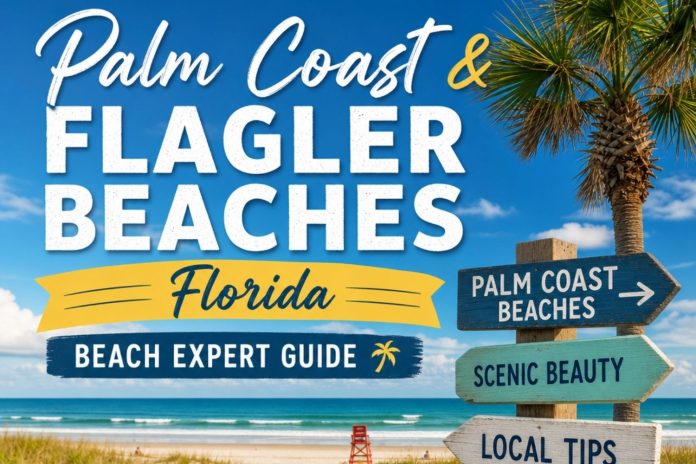
Palm Coast & Flagler Beaches, Florida
Flagler Beach calls itself the last old Florida beach town on the east coast, and after walking nineteen miles of this county’s coastline, I’m not going to argue with them. There’s not a single high-rise here. The buildings still stop short of the dunes. And the whole town has spent a century deciding, storm after storm, that a wooden fishing pier was worth rebuilding one more time rather than walking away from.
This guide covers the full stretch of Flagler County’s Atlantic coast south of Marineland and Washington Oaks Gardens State Park, from the quiet beach parks tucked into the Hammock, through the town of Flagler Beach itself, down past Beverly Beach toward Gamble Rogers Memorial State Recreation Area, which gets its own dedicated guide just south of here. Palm Coast, the planned community that sits mostly along the Intracoastal side of this same stretch, adds its own beach parks and a very different, more residential character to the mix.
In this guide I’m covering the Hammock’s quieter beach parks, the town of Flagler Beach and its pier, Beverly Beach, and Palm Coast’s own beach access points and Intracoastal side. I’ll go deep on what makes this cinnamon-colored coquina sand and this exposed stretch of surf different from the beaches further north, score it honestly across every category that matters, tell you exactly who this coast fits and who might want the amenities of a bigger beach town instead, and cover exactly which stretches welcome your dog. I close with my honest take on why a town this small has earned this much loyalty from the people who live there.
The Vibe & Culture at Palm Coast & Flagler Beaches
The Last Old Florida Beach Town, On Purpose
Flagler Beach didn’t stay small by accident. It stayed small because the railroad never came through, and every generation since has fought, sometimes literally against the ocean itself, to keep it that way.
The modern town traces back to 1909, when the Bunnell Development Company began selling lots on this barrier island, some by mail order, to families looking for a fresh start. Homesteader George Moody built the first house in 1914, opened a casino in 1916, and by 1925 the community had incorporated as Flagler Beach, named for railroad and oil magnate Henry Flagler, even though his Florida East Coast Railway actually ran several miles inland. That detail matters more than it sounds like it should. Because the train never stopped here, Flagler Beach never got the commercial growth spurt that turned so many other Florida coastal towns into resort corridors, and it’s remained small, quiet, and stubbornly old Florida for exactly that reason.
The pier has anchored this town’s identity since 1928, three years after incorporation, and it has spent nearly a century in a running battle with the Atlantic. A 1944 storm tore off half of it. A 1984 nor’easter took another 432 feet. Hurricane Matthew stripped 160 feet more in 2016 and undermined over a mile of A1A on the south end of town. Hurricane Ian caused further damage in 2022. Each time, the town rebuilt. As of 2026, a full reconstruction is underway, replacing the wooden pilings with reinforced concrete while preserving the original first 100 feet closest to shore and salvaging historic boards from earlier rebuilds. The goal is a pier that can stand for another century, funded almost entirely through FEMA and state disaster recovery money.
That same stubborn, community-first character shows up everywhere else in town. Grampa’s Uke Joint sells ukuleles. High Tides at Snack Jack has served surfers funky, unpretentious food out of a 1950s fish shack for decades. The Village Green across from where the old Flagler Beach Hotel once stood is now surrounded by cafes, boutiques, and City Hall rather than a resort tower. Even the town’s most famous recent visitor story fits the pattern. Charles Lindbergh reportedly stayed at the old Flagler Beach Hotel and preferred slipping out the back to fish alone on the rocks north of town rather than deal with a crowd. That’s still basically the town’s whole personality, and it’s exactly why I keep coming back.
Palm Coast & Flagler Beaches Areas: Five Stretches, One Old Florida Coast
Nineteen miles of coastline run through Flagler County, and each stretch has its own personality even though none of them ever feels far from the last. Here’s how I break it down.
The Hammock’s Beach Parks: Varn Park, Malacompra & Old Salt Road
North of Town · Quiet, Coquina Rock, Genuinely Local
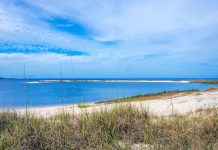
North of Flagler Beach proper, a stretch of coastline locals simply call the Hammock holds a handful of county beach parks that stay noticeably quieter than downtown. Varn Park is the most complete of them, with wheelchair-accessible beach access, ample parking, and a boardwalk crossing a genuine dune cliff before the sand drops away toward the water. Malacompra Park hides a shaded path to the beach behind its community center parking, and both it and Old Salt Road Park sit right against coquina rock outcroppings, beautiful to look at but genuinely unsuited to casual swimming because of submerged rocks and strong currents.
The crowd here skews local, surf anglers working the rocks for blues, whiting, and flounder, scrub jays and shorebirds drawing a steady trickle of birders, especially along the wires between Varn Park and the Matanzas Inlet, and families who’ve learned these lots fill up fast during sea turtle nesting season. It’s a noticeably different pace than the pier a few miles south.
My honest take, come here specifically for the quiet and the coquina rock scenery, not for a swim. If you want water you can actually get into, Varn Park is your best bet of this trio, but even there, check conditions before wading in deep.
Flagler Beach Pier & Downtown
South 6th Street · The Heart of Town
This is the Flagler Beach everyone pictures, a wooden pier reaching into the Atlantic, the Funky Pelican serving fried flounder sandwiches with an ocean view, and a downtown small enough to walk in twenty minutes. As of 2026 the pier itself is mid-reconstruction, rebuilding to its original 800-foot length with reinforced concrete pilings, but the beach on either side stays open, and the Funky Pelican and the pier’s A-frame entryway, now home to local radio station Surf 97.3 FM, remain fixtures regardless of construction status.
The crowd downtown is the busiest on this whole stretch, families near the pier, surfers checking the break, and a steady flow of visitors working through the shops, cafes, and the Flagler Beach Historical Museum a few blocks off the beach. Head a few blocks south toward 7th Street and the crowd thins fast while you’re still close enough to walk back for lunch.
My honest take, budget real time for the Historical Museum’s Downtown Historic Walking Tour before you write this off as just a beach stop. Learning about George Moody, the Wickline family, and the century of storms this town has weathered changes how the whole place feels once you’re back on the sand.
The A1A Beachfront Strip
Free Shoulder Parking · A Genuine Surf Coast
Much of Flagler Beach’s charm comes down to one unusual, deeply practical detail, you can park for free directly on the shoulder of A1A along most of the town’s length, and simply walk over to the sand from your car. This stretch is fully exposed Atlantic coastline, with no barrier islands or significant inlet to blunt incoming swell, which is exactly why Flagler Beach has built a genuine reputation as a surfer’s coast rather than a calm, family swim beach in the classic Panhandle sense.
The crowd along this open stretch mixes surfers timing the tide, dog walkers working the designated pet-friendly zones north and south of 10th Street, and beachgoers who’ve simply pulled over wherever looked good that day. Winter adds a genuinely rare draw. North Atlantic right whales, one of the most endangered large whale species on Earth, come close to shore here to calve between December and February, and when one’s spotted, the pier area fills with people scanning the water.
My honest take, respect the dune vegetation absolutely everywhere along this strip. Code enforcement here is serious about protecting the dunes, and for good reason, since this coast has no barrier island buffer to fall back on when a storm comes through.
Beverly Beach
Between Flagler Beach and the Hammock · Small and Residential
Beverly Beach is easy to drive through without registering it as its own place, a small, mostly residential community tucked between Flagler Beach proper and the Hammock to the north. There’s no commercial strip here, no pier, just a quiet stretch of the same beach corridor lined with modest homes and a handful of vacation rentals.
The crowd here is thin, almost entirely residents and the guests staying in the area’s rental cottages, since there’s little reason for a day-tripper to stop specifically at Beverly Beach rather than continuing on to Flagler Beach’s amenities.
My honest take, this is a good base if you want proximity to Flagler Beach’s downtown without staying in the middle of it. It’s not a destination in itself, but it’s a genuinely peaceful place to rent a cottage for a week.
Palm Coast’s Beach Access & Intracoastal Side
European Village & Bings Landing
Palm Coast itself, a planned community built out from the 1970s onward around more than 70 miles of saltwater and freshwater canals, sits mostly west of the Intracoastal Waterway, which means its character shows up more on the river side than the ocean side of this guide. European Village, a Mediterranean-style plaza of shops and restaurants on the Intracoastal, and Bings Landing, where you can view the ruins of the old Mala Compra Plantation and rent a kayak on weekends, both give you a genuine feel for Palm Coast’s identity as a boating and canal community rather than a classic beach town.
The crowd here is different again, boaters and paddlers on the water, diners at European Village in the evening, and residents of the area’s canal-front neighborhoods who treat the Intracoastal as their own backyard the way beach towns treat the surf. It’s worth a stop specifically because it shows you the other half of what Flagler County actually is, since most visitors only ever see the ocean side.
My honest take, if you’re staying inland in one of Palm Coast’s canal communities, don’t skip a sunset at European Village or an evening paddle from Bings Landing. It’s a genuinely different, worthwhile side of this county.
Palm Coast & Flagler Beaches Rankings: Expert Scores Across 11 Categories
These scores weigh the whole county corridor, from the quiet Hammock parks through downtown Flagler Beach and out to Palm Coast’s Intracoastal side.
Sand Quality
8/10
A distinctive cinnamon-orange color from crushed coquina shell, coarser than a powdery quartz beach but genuinely striking to look at and easy to walk on when hard-packed.
Hiking & Beach Walking
8/10
Nineteen miles of largely uninterrupted, hard-packed coastline, with a paralleling bike trail for anyone who wants to cover ground on wheels instead of on foot.
Shelling
6/10
Decent throughout, genuinely good among the coquina rock at the Hammock’s beach parks, though this coast is better known for surf and sand color than for shelling specifically.
Water Conditions
7/10
A genuinely good, consistent surf coast thanks to full exposure to the open Atlantic, with no lifeguards at most access points, so swim at your own risk and respect the current.
Scenery & Natural Beauty
9/10
No high-rises anywhere along this coast, a rarity in Florida, with open dune views, modest cottages, and the oak-canopied Hammock adding real character further inland.
Birding & Wildlife
8/10
Scrub jays and shorebirds throughout the Hammock’s parks, a migratory stopover in spring and fall, and one of the rarer winter draws anywhere on this coast, North Atlantic right whales calving close to shore.
Family Friendliness
8/10
Free parking, a walkable downtown, and a pier that’s anchored generations of family trips make this a genuinely easy, low-stress beach town for families.
Dog Friendliness
7/10
Genuinely good, with designated pet-friendly zones north and south of 10th Street and an annual dog surfing event, though the core downtown stretch itself is off-limits to dogs.
Solitude & Peace
7/10
Downtown and the pier carry real foot traffic in season, but the Hammock’s beach parks and Beverly Beach both deliver genuine quiet within a short drive.
Entertainment & Nightlife
7/10
First Friday events, a music festival, and a genuinely good small restaurant scene, though this stays old Florida in scale rather than a full nightlife destination.
Parking & Beach Access
8/10
Free shoulder parking along most of A1A in town, plus free lots at the county beach parks, make this one of the easier beaches to access in this entire guide.
Palm Coast & Flagler Beaches Sand & Water
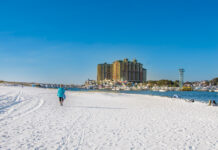
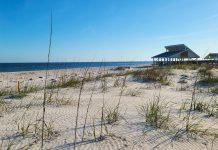
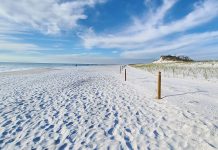
The sand here runs a warm cinnamon to orange color that you won’t see much further north on this coast, and it packs down firm enough near downtown that beach cruisers handle it easily. The beach stays wide and flat for most of its length, plenty of room for a blanket, a game of catch, or a long walk, and it softens up a bit near the dunes for sandcastles once the sand’s had some water worked into it. This is a genuinely comfortable, easy beach to spend a full day on.
The water here is real, honest Atlantic surf, since this coast sits fully exposed with no barrier island to soften incoming swell. On a calm day it runs a deep, clear blue, and entry is gradual almost everywhere, but expect actual waves rather than a flat swim, and most access points have no lifeguard on duty. Rip currents are a genuine risk here, so check conditions and respect posted flags before you wade in past your knees.
-
Walkability. Wide, flat, and hard-packed near downtown, genuinely good for a long walk or a bike ride along the shoreline.
-
Softness & Playability. Firmer near the water, softer up near the dunes, with plenty of room for sandcastles, games, and a group blanket.
-
Barefoot Comfort. Comfortable through most of downtown, a bit rougher near the rockier Hammock parks further north.
-
Swimmability. Real surf with no lifeguard at most access points. Respect the flags and rip current risk, especially away from the busiest stretch near the pier.
Want the full geology, grain composition, and the complete sand and water condition ratings? I broke it all down separately in Sand & Shore: Palm Coast & Flagler Beaches.
Dogs & Pet Accessibility at Palm Coast & Flagler Beaches
Are Dogs Allowed on the Sand? RESTRICTED.
Your leashed dog is welcome on the beach in designated zones north and south of 10th Street, but the central downtown stretch right around the pier stays off-limits. Know which zone you’re in before you head down.
Where Dogs Are Allowed
- ✓The beach north of 10th Street, on a leash, no time-of-day restriction.
- ✓The beach south of 10th Street, on a leash, same rule.
- ✓The free A1A shoulder parking areas and most of the town’s sidewalks and shops.
Where Dogs Are NOT Allowed
- ✗The central downtown beach stretch immediately around the pier.
- ✗On the pier itself, along with alcohol, which also isn’t permitted there.
Paws on the Ground Reality
The hard-packed sand in the dog-friendly zones stays comfortable for paws most of the year, and you’re never far from the water for a quick cool-down. Bring your own water anyway, since fountains are sparse right on the beach. Enforcement is genuinely visible here, especially in season, since this town takes its zoning seriously and signage is posted clearly at every access point.
The annual Hang 8 Dog Surfing event each year turns the whole town into a celebration of exactly this kind of beach-going dog, so if your visit lines up with it, don’t miss it.
Crowd Levels and the Overall Feel of Palm Coast & Flagler Beaches
The crowd concentrates around the Flagler Beach pier and downtown, especially near 7th Street and closer to the sand. The Hammock’s beach parks and Beverly Beach both stay noticeably quieter, and Palm Coast’s Intracoastal side draws its own separate crowd of boaters and diners rather than beachgoers.
The overall feel shifts by season and by nearby Daytona’s event calendar as much as by weather:
- Spring: comfortable crowds, good surf, and strong migratory birding through the Hammock’s parks
- Summer: peak season downtown, with the pier area at its busiest and the Hammock parks still offering an easy escape
- Fall: my favorite window here, consistent surf, thinner crowds, and comfortable temperatures for the historic walking tour
- Winter: quiet on land but genuinely exciting on the water, with right whale sightings drawing crowds to the pier when word gets out
Also worth knowing, lodging fills fast countywide during nearby Daytona International Speedway event weeks, including Speedweeks in mid-February, Bike Week in early March, the Coke Zero 400 around July 4th, and Biketoberfest in mid-October.
Who Are Palm Coast & Flagler Beaches Really For?
✓ Who Will Love Palm Coast & Flagler Beaches
-
Surfers looking for a genuine, consistent break without the crowds of a bigger Florida surf town
-
Anyone who specifically wants a beach town with no high-rises and a real, walkable small-town center
-
Winter visitors hoping for a rare shot at seeing North Atlantic right whales close to shore
-
Dog owners who plan around the designated pet-friendly zones north and south of 10th Street
-
History lovers who want a genuine small-town story behind the beach, not just a scenic backdrop
-
Anglers and paddlers who want both surf fishing and Intracoastal access within a short drive of each other
✗ Consider Another Beach If…
-
You want a big resort or high-rise beach experience. This coast is built the opposite way, on purpose
-
You need lifeguarded swimming at every access point. Most beach parks here have no lifeguard on duty
-
You’re traveling during a major Daytona Speedway event week without a reservation. Lodging fills fast countywide during those windows
-
You want soft, powdery white sand. This coast’s coquina-tinted sand runs coarser and more orange-toned
-
You want a big nightlife scene. Flagler Beach stays small and quiet after dark, by design
Things to Do at Palm Coast & Flagler Beaches, Florida
Between the beach corridor and the Intracoastal side, this county offers a genuinely wide range of things to do.
-
Surfing. Consistent, genuine surf along the exposed Flagler Beach coastline, with no barrier island to blunt the swell.
-
Pier Fishing. The Flagler Beach Pier, mid-reconstruction as of 2026, has been a fishing landmark since 1928, with pompano, whiting, flounder, black drum, and redfish all regularly caught.
-
Whale Watching. North Atlantic right whales calve close to shore here between December and February, best watched from the pier area.
-
Biking. A paved trail parallels much of A1A, connecting the Hammock’s beach parks through downtown Flagler Beach and beyond.
-
Dog Beach Days. Designated pet-friendly zones sit north and south of 10th Street, and the annual Hang 8 Dog Surfing event turns the town into a genuinely fun spectacle.
-
The Downtown Historic Walking Tour. A self-guided route past the Wickline Store site, the George Moody House, and the Flagler Beach Historical Museum.
-
Kayaking & Paddleboarding. Bings Landing on the Intracoastal side offers weekend kayak rentals alongside views of the historic Mala Compra Plantation ruins.
-
Birding. Scrub jays and shorebirds throughout the Hammock’s beach parks, with strong activity during spring and fall migration.
-
Eating at Flagler Beach Institutions. The Funky Pelican for an ocean view, High Tides at Snack Jack for surf-shack charm, and a genuine local farmers market on weekends.
-
Exploring European Village. A Mediterranean-style plaza of shops and restaurants on Palm Coast’s Intracoastal side, a very different feel from the ocean side of the county.
Local Knowledge and Practical Advice
A few things I’ve picked up walking this coast more times than I can count:
-
Park free on the A1A shoulder, but respect yellow curbs downtown. They tow, especially during events like Hang 8 Dog Surfing or Cheer at the Pier.
-
Know the dog zones before you bring your pet. Dogs are welcome north of 10th Street and south of 10th Street, but not in the central downtown stretch.
-
Never let your feet, tires, or towels touch dune vegetation. Code enforcement is genuinely strict here, since this exposed coast has no barrier island to fall back on if the dunes erode.
-
Check the pier’s current construction status before planning around it. The full rebuild is underway as of 2026, with completion targeted for late 2026 or into 2027.
-
No alcohol is allowed on the pier itself. It keeps the atmosphere genuinely family-friendly.
-
Book lodging early during Daytona Speedway event weeks. Speedweeks, Bike Week, the Coke Zero 400, and Biketoberfest all pull rooms up and down this coast.
-
Skip the Hammock’s rockier parks if swimming is your main goal. Malacompra and Old Salt Road are better for scenery and shelling than for getting in the water.
-
Watch the water near the pier in winter. Right whale sightings are rare and genuinely special, and word travels fast locally when one’s been spotted.
-
Visit the Historical Museum before you explore downtown. Understanding George Moody’s original vision and the town’s century of storms changes how the whole place feels.
-
Don’t skip the Intracoastal side. Bings Landing and European Village show you a genuinely different half of what this county actually is.
Where to Stay Near Palm Coast & Flagler Beaches, Florida
This county offers everything from classic mom-and-pop motels to a major hotel now in development, plus camping just south of town.
Classic A1A Motels
Flagler Beach’s stretch of A1A is lined with old-school, family-run motels, genuinely in keeping with the town’s old Florida character and easy walking distance to the beach.
The Margaritaville Hotel, In Development
A new Margaritaville Hotel is planned for the site of the historic Flagler Beach Hotel, expected to open close to the 100th anniversary of the original 1925 hotel. Check current status before booking around it.
Vacation Rentals in Beverly Beach & Along A1A
Beverly Beach and the residential stretches of A1A offer quieter cottage and home rentals within a short drive of downtown Flagler Beach.
Palm Coast Canal-Front Rentals
Palm Coast’s extensive canal community offers a different kind of stay, boat docks and Intracoastal access, a short drive from the ocean beaches.
Camping at Gamble Rogers Memorial State Recreation Area
Just south of Flagler Beach, this park offers both beachfront and river-side camping. It’s covered in its own dedicated guide, since it deserves a closer look on its own terms.
What Makes Palm Coast & Flagler Beaches Different from Nearby Beaches
This stretch of coast stands apart because it made a deliberate choice, generation after generation, not to grow the way most of Florida’s coastline has. Every other beach town in this guide either grew up around a resort or a fort. This one grew up around a pier and simply decided that was enough.
A few features make it distinct:
No high-rises, anywhere
This is one of the only stretches of developed Florida beach in this entire guide with a genuinely enforced low-rise skyline, and it fundamentally shapes how open and unhurried the whole coast feels.
A pier that keeps getting rebuilt, not replaced
Few Florida landmarks have survived this many direct hits and still come back as the same structure in spirit, wooden pilings and all, generation after generation.
A genuine surf identity
Full exposure to the open Atlantic, with no barrier island buffer, gives this coast real, consistent surf that few other beaches in this guide can match.
Right whales in winter
Very few beaches anywhere in Florida offer a realistic chance at seeing one of the rarest large whales on Earth calving close to shore.
Palm Coast & Flagler Beaches vs. Other Northeast Florida Beaches
These are the beaches visitors most often weigh against this stretch, and the honest read on when you’d choose one over the other.
Palm Coast & Flagler Beaches vs. St. Augustine Beaches
St. Augustine Beach offers considerably more amenities, dining, and a major historic district nearby. Flagler Beach trades all of that for a smaller scale, free parking, and a genuinely quieter, more residential feel.
Palm Coast & Flagler Beaches vs. Washington Oaks & Marineland
Both neighbors to the north, Washington Oaks and Marineland, lean into geology and history over beach amenities. Flagler Beach gives you an actual functioning beach town alongside the natural scenery.
Palm Coast & Flagler Beaches vs. Ormond Beach & Daytona Beach
Both to the south allow more extensive beach driving and offer a bigger, louder beach town scale. Flagler Beach stays smaller and quieter, with no cars permitted on its sand.
Palm Coast & Flagler Beaches vs. Gamble Rogers Memorial State Recreation Area
Gamble Rogers, just south, offers a more protected, campground-centered experience within the same coastal corridor. The two pair naturally for a multi-day trip.
Bottom line: Palm Coast and Flagler Beaches are the choice for anyone who wants a real, lived-in beach town rather than a resort corridor. St. Augustine gives you more amenities and history. Ormond and Daytona give you more scale. Flagler Beach gives you a pier that keeps rebuilding itself, cinnamon-colored sand, and a coast that genuinely earns its old Florida reputation.
Palm Coast & Flagler Beaches, Florida: Frequently Asked Questions
Can you drive on Flagler Beach?
No, vehicles are not permitted on the sand in Flagler Beach. Free shoulder parking along A1A makes a vehicle unnecessary for reaching the beach itself.
Is Flagler Beach good for surfing?
Yes, genuinely so. Full exposure to the open Atlantic with no barrier island buffer gives this coast consistent, real surf.
Are dogs allowed on Flagler Beach?
Yes, in designated zones north and south of 10th Street. The central downtown stretch of beach is not open to dogs.
Where can I park in Flagler Beach?
Free on the shoulder of A1A along most of the town, with additional free lots at the county beach parks in the Hammock. Watch for yellow curbs downtown, which are strictly enforced.
Is the Flagler Beach Pier open?
As of 2026, the pier is undergoing a full reconstruction, rebuilding to its original length with reinforced concrete pilings. Check current status before planning a fishing trip specifically around it.
Can you see whales at Flagler Beach?
Yes, North Atlantic right whales, among the rarest large whales in the world, calve close to shore here between December and February. The pier area is the most reliable spot to watch.
Is Flagler Beach crowded?
Downtown and the pier area get busy in season, but the Hammock’s beach parks and Beverly Beach both stay noticeably quieter year-round.
What is Palm Coast, and is it different from Flagler Beach?
Palm Coast is a separate, larger planned community built primarily around an extensive canal system on the Intracoastal side of the county. Flagler Beach is the smaller, older beach town on the ocean side. Both share the same county and much of the same coastline.
Is Flagler Beach good for families?
Yes, with free parking, a walkable downtown, and a pier that’s anchored family trips here for generations, though most beach access points have no lifeguard on duty.
When is storm risk highest along this coast?
Hurricane season runs June through November, and this fully exposed stretch of coast, with no barrier island buffer, has a documented history of significant storm damage during that window.
Patti’s Perspective: My Honest Take on Palm Coast & Flagler Beaches
I still think about the first time I heard someone mention a right whale sighting near the pier, and how the whole conversation around me shifted immediately, phones out, everyone scanning the water together. I’ve watched dolphins from a hundred different Florida beaches by now. I had never, until that morning, watched an entire small town beach quietly unite around watching for something that rare and that fragile.
My honest caveat, don’t come here looking for a big resort experience, because you won’t find one, and that’s the whole point. Come here for a walkable pier town, real surf, and a community that has decided, repeatedly and on purpose, to stay exactly the size it already is.
Want to Live by the Water?Flagler County offers one of the more affordable, genuinely low-rise coastal real estate markets left in Northeast Florida, from classic beach cottages in Flagler Beach and Beverly Beach to canal-front homes throughout Palm Coast’s extensive waterway system.The market here draws retirees, remote workers, and buyers priced out of the more developed markets further north, with Palm Coast’s canal lots offering private boat access at a fraction of oceanfront prices. Flagler Beach’s strict low-rise character has also helped protect long-term property values by keeping the town’s essential scale intact.If living along this stretch of old Florida coastline, whether beachfront or canal-front, is something you’re considering, it’s worth exploring what’s available in this area.Explore Waterfront Living at LiveByTheWater.com
Real estate referral partner