



Marineland Area Beaches, Florida
Marineland is the strangest, smallest, and in some ways most important stop in this entire guide, and almost nobody outside Northeast Florida knows it’s there. This is the town, barely a town at all by population, where the whole idea of a marine park was invented in 1938, and where a handful of coquina-rock beaches and a genuinely quiet stretch of A1A mark the transition from St. Johns County into Flagler County.
This corridor runs south from the Matanzas Inlet through the Town of Marineland, the River to Sea Preserve, and down to Jungle Hut Road Park, right at the edge where St. Johns County beaches give way to Palm Coast and Flagler Beach. It’s short. It’s underdeveloped. And as of 2026, it’s also home to one of the better comeback stories I’ve covered anywhere on this coast, a nearly 90-year-old marine park that came within weeks of being sold off for redevelopment and was instead saved by a small group of people who refused to let that happen.
In this guide I’m covering Marineland Dolphin Adventure and the tiny town that grew up around it, the River to Sea Preserve’s beach boardwalk and coquina outcroppings, a brief look ahead at Washington Oaks Gardens State Park just south, and Jungle Hut Road Park, one of my personal favorite quiet access points on this entire coast. I’ll go deep on what makes this rocky, coquina-heavy stretch of sand different from the beaches further north, score it honestly across every category that matters, tell you exactly who this stretch fits and who should keep driving to a beach with softer sand and fewer rocks, and cover exactly where you can bring your dog along this corridor. I close with my honest take on why I keep coming back to a corridor most people drive straight through.
The Vibe & Culture at Marineland Area Beaches
The Smallest Town With the Biggest Idea
In 1938, three men with connections to Hollywood built underwater filming tanks on an empty stretch of Florida coast because scuba diving hadn’t been invented yet and there was no other way to shoot marine life on camera. That idea became the world’s first oceanarium, and the tiny town that grew up around it still carries almost none of the polish you’d expect from something with that kind of legacy.
Marineland, originally called Marine Studios, opened on June 23, 1938, founded by W. Douglas Burden, Cornelius Vanderbilt Whitney, and Ilya Tolstoy, grandson of the Russian novelist. More than 20,000 visitors clogged the two-lane highway to see it in its first weeks, and the park went on to pioneer discoveries in dolphin echolocation and communication, host film shoots for Creature from the Black Lagoon and its sequels, and welcome guests including Eleanor Roosevelt, Ernest Hemingway, and Florida author Marjorie Kinnan Rawlings, whose husband ran the park’s restaurant and lounge. The Town of Marineland incorporated in 1946 and remains, to this day, one of the smallest municipalities in Florida.
That legacy nearly ended in 2025. The park’s former parent company filed for bankruptcy, and a Texas real estate developer moved to buy the property, a deal that would very likely have meant relocating every dolphin and paving over 88 years of history. A bankruptcy judge refused to approve that sale, citing the public outcry from conservationists, students, and longtime staff, and a Clay County couple stepped in with a winning bid to keep Marineland open. Management passed to Felicia Cook, a former general manager who returned to lead the park through her own nonprofit, Marineland Waves of the Future, and as of Marineland’s 88th anniversary in June 2026, the park is not just surviving, it’s actively rebuilding itself around education, conservation, and research rather than the theme-park model that nearly ended it.
The present-day feel of this whole corridor matches that quiet, rebuilding spirit. There’s no strip of restaurants here, no boardwalk scene, nothing resembling a beach town in the way St. Augustine Beach or Flagler Beach are beach towns. What you get instead is a working marine research facility, a genuinely wild stretch of coquina-rock coastline, and a Sunday farmers market at the marina that feels more like a community gathering than a tourist stop. I send people through here specifically because it’s the version of old Florida that most of this coast has already built over.
Marineland Area Beaches: Four Stops on a Short, Quiet Stretch
This corridor is short enough to cover in a single unhurried day, but each stop has its own distinct character. Here’s how I break it down.
Marineland Dolphin Adventure & the Town of Marineland
9600 Oceanshore Blvd · The World’s First Oceanarium
Marineland Dolphin Adventure sits right on the ocean, a small, intimate facility that feels nothing like the mega-parks it eventually inspired. General admission includes the Sea to Shore Aquarium, Ambassador Park with its tortoises and sea turtles, and Whitney Park, where you can watch dolphins from above and below the waterline. Deeper interactions, including in-water dolphin programs, are available for an additional fee, and I’d genuinely recommend booking ahead given the park’s ongoing rebuild under new ownership.
The crowd here skews toward families who came specifically for the dolphin encounter, history buffs who know the park’s Hollywood past, and a growing number of returning locals who want to support the park through its comeback. It’s a fraction of the size and crowd you’d find at a Central Florida marine park, and that’s precisely the appeal, small groups, real access to the animals and the staff, and a pace that doesn’t rush you through.
My honest take, don’t judge this park by its recent hard years. What I found on my last visit was a staff that genuinely believes in what they’re rebuilding, and a dolphin encounter that felt more personal than anything I’ve experienced at a bigger facility. Check current hours and reservation requirements before you go, since the schedule has shifted more than usual during the ownership transition.
River to Sea Preserve
9805 N. Oceanshore Blvd · Boardwalk, Coquina Rock, Kayak Launch
Just north of the main Marineland attraction, the River to Sea Preserve spans both sides of A1A, jointly owned by Flagler County and the Town of Marineland, and it protects 90 acres of increasingly rare maritime scrub habitat. A boardwalk rises over the dune bluff to a genuinely striking beach view, and at low tide you’ll see coquina rock formations exposed along the shoreline, a preview of what makes Washington Oaks Gardens State Park a little further south so distinctive. On the river side, a hand launch gives kayakers and canoers direct access to the Intracoastal Waterway and the Matanzas River.
The crowd here is thin and purposeful, paddlers launching for the day, a handful of beachgoers who know to bring water shoes for the rocks, and visitors walking over from Marineland itself, since the preserve sits close enough to make it an easy add-on. Because this preserve falls within the broader footprint of the Guana Tolomato Matanzas National Estuarine Research Reserve, the birding here is genuinely good, and dolphins are a regular sight just offshore.
My honest take, don’t skip the beach side just because the parking is on the river side of the highway. The walk over the dune boardwalk is short, and the view from the top, especially with the rock formations visible below, is one of the better quiet moments on this whole stretch of coast.
Washington Oaks Gardens State Park (A Preview)
Just South on A1A · Coquina Beach, Historic Gardens
A short drive south of Marineland, Washington Oaks Gardens State Park pairs formal historic gardens on the Intracoastal side with a beach on the Atlantic side defined by dramatic, wave-carved coquina rock formations unlike anything else on this stretch of coast. I’m giving it only a brief mention here on purpose. Between the gardens, the rock beach, and the park’s own layered history, it genuinely deserves its own dedicated guide rather than a few paragraphs folded into this one, so look for that separately.
What I’ll say for now is that if the coquina rock at River to Sea Preserve caught your eye, Washington Oaks is where that same geology puts on its best show, and it’s an easy, worthwhile stop between Marineland and Jungle Hut Road Park.
Jungle Hut Road Park
101 Jungle Hut Road, Palm Coast · My Favorite Quiet Access Point
Jungle Hut Road Park marks the practical southern edge of this guide, right at the edge where St. Johns County’s beach corridor hands off to Palm Coast and Flagler Beach. A short walk from the parking lot gets you to the sand, either over a wooden walkway with stairs or via a more direct path just south of the lot, and the beach itself carries the same coquina rock character as the rest of this stretch, genuinely scenic, but one where you need to watch your footing and respect the current.
Behind the beach, a roughly one-mile loop trail winds through a shaded hardwood hammock, a completely different experience from the open coastline just a few hundred feet away, and it’s a genuinely good option on a day when the sun is too strong for a long beach walk. Small picnic pavilions with grills round out the amenities, and the crowd here stays thin even on busy weekends, since most visitors never venture this far off the main tourist path.
This is one of my personal favorite access points on this entire coast, precisely because so few people know to look for it. My honest take, come for the beach, stay for the hammock trail, and don’t rush either one.
Marineland Area Beaches Rankings: Expert Scores Across 11 Categories
These scores reflect a corridor built around history, wildlife, and quiet rather than swimming and amenities, which is exactly what this stretch has always been.
Sand Quality
7/10
A quartz-and-coquina blend interrupted by genuine rock outcroppings at several access points, scenic and distinctive rather than classically soft and powdery.
Hiking & Beach Walking
7/10
Shorter beach stretches than further north, balanced out by genuinely good inland trail options, especially the hardwood hammock loop at Jungle Hut Road Park.
Shelling
7/10
Genuinely good beachcombing among the coquina rock formations, especially at low tide when more of the rocky shoreline is exposed.
Water Conditions
5/10
Submerged rocks and real current risk are called out at nearly every access point along this stretch. Beautiful to look at, genuinely something to respect before you swim.
Scenery & Natural Beauty
9/10
Among the most distinctive coastline in this whole guide, coquina rock formations, oak hammock, dune bluffs, and a GTM Reserve backdrop with almost nothing built up around it.
Birding & Wildlife
8/10
Dolphins are a near-daily sight from River to Sea Preserve and Marineland itself, and the surrounding GTM Reserve habitat keeps birding consistently strong throughout this corridor.
Family Friendliness
7/10
Marineland itself is genuinely great for kids, though the rocky beaches along this stretch take more supervision than a soft, open swim beach.
Dog Friendliness
8/10
Leashed dogs are welcome at River to Sea Preserve and Jungle Hut Road Park, both genuinely pleasant, low-crowd spots for a dog walk.
Solitude & Peace
9/10
One of the quietest stretches in this entire guide. Most visitors drive straight through on their way somewhere else, which is exactly what keeps it this peaceful.
Entertainment & Nightlife
3/10
Marineland itself and the Sunday Salt Air Farmers Market at the marina are essentially it. Everything else is a drive north or south.
Parking & Beach Access
6/10
Free, modest-sized lots at each access point, generally uncrowded, though there’s no large commercial parking infrastructure anywhere on this stretch.
Marineland Area Beaches Sand & Water
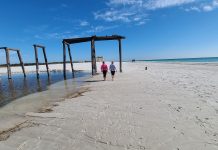
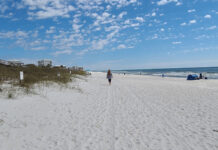
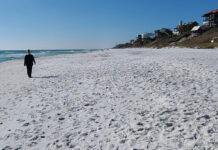
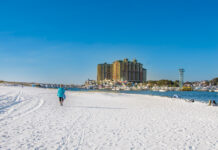
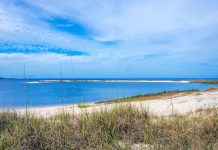
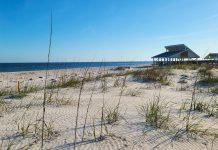
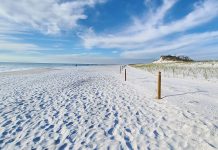
This stretch of sand keeps close company with exposed rock, so don’t expect a flat, uniform beach from one end to the other. You’ll find open, walkable patches of sand between the rock outcroppings, soft enough for sandcastles once you’ve worked in some water, but the rockier zones ask for real attention to where you’re stepping. It’s a genuinely scenic beach to look at, with dark, weathered rock breaking up the sand in a way you won’t see further north on this coast, and there’s enough open ground for a picnic or a slow, careful walk.
The water here comes with a consistent warning worth repeating, since nearly every park along this stretch posts it, submerged rocks and real current. On a calm day the water runs a typical deep Atlantic blue-green, but the rocky bottom means footing matters more than usual, and you’ll want to wade in slowly and watch where you’re putting your feet rather than diving straight in. This isn’t a beach built for casual, carefree swimming.
-
Walkability. Comfortable in the open sand patches, considerably trickier near the rock zones, where sturdy shoes make the difference.
-
Softness & Playability. Soft enough for sandcastles between the rock outcroppings, though this isn’t a beach for spreading out a blanket without checking the ground first.
-
Barefoot Comfort. The weak point here. Bring water shoes, since the rock formations that make this coastline so scenic are genuinely hard on bare feet.
-
Swimmability. Depends heavily on the specific spot and tide. Watch for exposed rock and real current before wading in anywhere along this stretch.
Want the full geology, grain composition, and the complete sand and water condition ratings? I broke it all down separately in Sand & Shore: Marineland Area Beaches.
Dogs & Pet Accessibility at Marineland Area Beaches
Are Dogs Allowed on the Sand? YES.
Your leashed dog is welcome at both River to Sea Preserve and Jungle Hut Road Park, the two main stops along this corridor. Neither spot sees much crowd, which makes both genuinely pleasant for a dog walk.
Where Dogs Are Allowed
- ✓River to Sea Preserve, on a leash, including the boardwalk over the dune bluff and the beach below.
- ✓Jungle Hut Road Park, on a leash, both on the beach and along the hardwood hammock loop trail.
Where Dogs Are NOT Allowed
- ✗Inside Marineland Dolphin Adventure itself, which doesn’t permit outside pets on the property.
- ✗Washington Oaks Gardens State Park’s beach and gardens just south, covered in its own guide, where pets are restricted to trails and the picnic area.
Paws on the Ground Reality
Bring your own water, since neither park has a reliable fountain along the beach itself, and think about a quick paw rinse afterward given how much rock your dog will be walking over. Enforcement here feels genuinely relaxed, since so few people pass through this corridor at all, and you’ll mostly cross paths with locals who already know their dogs are welcome.
If your dog wants more distance than the beach alone offers, the hardwood hammock loop trail at Jungle Hut Road Park adds a shaded, easy mile without ever leaving leash-friendly ground.
Crowd Levels and the Overall Feel of Marineland Area Beaches
This corridor stays quiet nearly everywhere, all the time. Marineland itself draws the steadiest traffic, mostly families and returning locals supporting the park’s comeback. River to Sea Preserve and Jungle Hut Road Park see a thin, steady trickle of kayakers, dog walkers, and people who specifically sought out a quieter stop.
The overall feel here shifts less by season than most beaches in this guide, since so little of the draw depends on swimming weather:
- Spring: comfortable crowds at Marineland, good conditions for kayaking and beachcombing among the rocks
- Summer: the busiest window at Marineland specifically, though the beach parks stay noticeably quieter than developed beaches further north
- Fall: my favorite season for this stretch, comfortable temperatures for the hammock trail at Jungle Hut and good birding throughout
- Winter: quiet and still, the best season for uninterrupted wildlife watching and a peaceful walk through the coquina rock zones
Who Are Marineland Area Beaches Really For?
✓ Who Will Love Marineland Area Beaches
-
Families and dolphin lovers who want a smaller, more personal marine park experience with real history behind it
-
Anyone who wants to see and support one of the more genuine comeback stories on Florida’s coast in 2026
-
Kayakers and paddlers looking for calm Intracoastal launch access into the GTM Reserve
-
Hikers who want genuine trail variety, hammock loops and dune boardwalks, alongside their beach time
-
Anyone chasing real solitude on a scenic, rocky stretch of coast most visitors drive straight past
-
Dog owners looking for a quiet, low-crowd beach walk
✗ Consider Another Beach If…
-
You want soft, rock-free sand for casual swimming. Head to Crescent Beach or St. Augustine Beach instead
-
You want restaurants, shops, or nightlife within walking distance. This corridor has almost none of that
-
You’re bringing small children into open water without close supervision. The rocky bottom here needs real attention
-
You need a big theme park experience. Marineland is intentionally small and low-key, not a mega-attraction
-
You want guaranteed, unchanging hours and programming. Marineland is still stabilizing under new ownership as of 2026, so double-check current details before you go
Things to Do at Marineland Area Beaches, Florida
This is a small corridor, but it offers real range for anyone willing to slow down and explore it properly.
-
Visiting Marineland Dolphin Adventure. The world’s first oceanarium, now rebuilding as a nonprofit focused on education, conservation, and research. Book ahead for in-water dolphin programs.
-
Kayaking & Canoeing. A hand launch at River to Sea Preserve gives direct access to the Intracoastal Waterway and the Matanzas River, within the broader GTM Reserve footprint.
-
Walking the Jungle Hut Hammock Loop. A roughly one-mile trail through shaded hardwood forest, a genuinely different experience from the open coastline nearby.
-
Beachcombing Among the Coquina Rock. Genuinely good shelling and rock-pool exploring at low tide, especially at River to Sea Preserve and Jungle Hut Road Park. My beach finds guide to this corridor covers what to look for.
-
Surf Fishing. Popular at Jungle Hut Road Park and the other beach parks along this stretch, with the rocky structure attracting good fish activity.
-
The Salt Air Farmers Market. Held Sundays at the Marineland Marina, a genuinely local, low-key gathering spot worth timing your visit around.
-
Birding & Dolphin Watching. Dolphins are a near-daily sight from River to Sea Preserve and around the Marineland Marina, and the GTM Reserve habitat keeps birding consistently strong.
-
Photographing the Dune Boardwalk at River to Sea Preserve. One of the better quiet viewpoints on this whole stretch of A1A.
Local Knowledge and Practical Advice
A few things I’ve picked up covering this quiet stretch more times than I can count:
-
Bring sturdy water shoes. The coquina rock formations along this whole stretch make barefoot exploring genuinely uncomfortable in spots.
-
Respect the current and rock warnings at every access point. They’re not generic caution, this stretch’s rocky structure genuinely changes how the water behaves compared to a straight sandy beach.
-
Check Marineland’s current hours and reservation policy before you go. The park is still stabilizing under new ownership as of 2026, and schedules have shifted more than usual during the transition.
-
Time a visit for Sunday if you want the farmers market. It’s held at the Marineland Marina and gives you a genuine feel for the small local community here.
-
Fill up on gas and snacks before you arrive. This is one of the smallest towns in Florida, and services are essentially limited to what Marineland itself offers.
-
Leashed dogs are welcome at River to Sea Preserve and Jungle Hut Road Park. Both are genuinely pleasant, low-crowd spots for a dog walk.
-
Walk the hammock loop trail at Jungle Hut even if the beach is your main goal. It’s a completely different, shaded experience worth the extra hour.
-
Bring a kayak or rent one if you can. The hand launch at River to Sea Preserve opens up some of the calmest, most scenic paddling on this coast.
-
Plan a separate visit to Washington Oaks Gardens State Park just south. Don’t try to squeeze it into the same day as everything else on this list. It deserves its own unhurried trip.
-
Visit at low tide for the best view of the coquina rock formations. They’re genuinely one of the more distinctive natural features on this whole coast.
Where to Stay Near Marineland Area Beaches, Florida
This corridor has essentially no lodging of its own beyond a small footprint at Marineland itself, so most visitors base themselves nearby.
Old Florida Fish Camps Along the Matanzas River
A handful of rustic, longstanding fishing lodges and cottage rentals sit along the Matanzas River corridor near this stretch, offering an old Florida alternative to a standard hotel stay.
Crescent Beach & St. Augustine, North
For more lodging variety and full amenities, Crescent Beach and downtown St. Augustine sit a comfortable drive north.
Camping at Princess Place Preserve
This Flagler County preserve, a short drive inland, offers both traditional and equestrian camping alongside an 1888 hunting lodge, the oldest standing structure in Flagler County.
Palm Coast & Flagler Beach, South
For a fuller range of hotels, vacation rentals, and restaurants, Palm Coast and Flagler Beach sit a short drive south, with their own dedicated guide covering that stretch in detail.
What Makes Marineland Area Beaches Different from Nearby Beaches
This corridor stands apart because almost nothing here was built for tourists in the modern sense. Every other beach in this guide grew around a resort, a boardwalk, or a town center. This one grew around a marine research experiment that happened to become a beloved attraction almost by accident.
A few features make it distinct:
A working piece of marine science history
Marineland’s role in discovering dolphin echolocation and signature whistles, and its ongoing comeback as a conservation-focused nonprofit, gives this corridor a genuine scientific legacy no other beach in this guide can claim.
Coquina rock coastline
The exposed rock formations along this stretch, leading directly into Washington Oaks Gardens State Park just south, are a genuinely distinctive geological feature rare elsewhere on Florida’s Atlantic coast.
One of the smallest towns in Florida
The Town of Marineland’s tiny scale gives this corridor a genuinely different character than any other stop in this guide, quiet not by accident, but by the sheer lack of anything else built here.
A comeback story worth witnessing
Very few attractions anywhere in Florida have come as close to disappearing and been saved as directly by public and community effort as Marineland was in 2025 and 2026.
Marineland Area Beaches vs. Other St. Johns County Beaches
These are the beaches visitors most often weigh against this corridor, and the honest read on when you’d choose one over the other.
Marineland Area Beaches vs. Matanzas Beaches
Matanzas, just north, offers a Spanish fort and a genuinely dangerous inlet current. Marineland offers a marine park, calmer paddling water, and a rockier, more scenic coastline overall.
Marineland Area Beaches vs. Crescent Beach
Crescent Beach gives you real amenities, easy parking, and softer sand for a relaxed beach day. Marineland gives you history, wildlife, and a rockier coastline that rewards a slower pace.
Marineland Area Beaches vs. Anastasia State Park
Anastasia offers a longer, more swimmable stretch of protected beach with real infrastructure. Marineland offers a shorter, quieter corridor built around a research legacy rather than a beach day.
Marineland Area Beaches vs. Washington Oaks Gardens State Park
Washington Oaks, just south, shares this stretch’s coquina rock character but adds historic formal gardens on the river side. The two make a natural pairing for a single unhurried day, even though each earns its own dedicated visit.
Bottom line: Marineland Area Beaches is the choice for history, marine science, and a genuinely quiet, rocky stretch of Florida coastline. Crescent Beach and Anastasia State Park give you more comfort and swimmable sand. Marineland gives you a small town with an outsized legacy and some of the most distinctive coastline in this entire guide.
Marineland Area Beaches, Florida: Frequently Asked Questions
Is Marineland Dolphin Adventure still open in 2026?
Yes. After its former parent company filed for bankruptcy in 2025, a Clay County couple purchased the park and passed management to Felicia Cook’s nonprofit, Marineland Waves of the Future, which now runs the park with a renewed focus on education, conservation, and research.
What happened to Marineland Dolphin Adventure?
Its former owner, The Dolphin Company, filed for bankruptcy in March 2025, and a Texas developer initially moved to purchase the property. A bankruptcy judge rejected that sale following public pressure, and new owners committed to keeping the park operating.
Can you swim at the beaches near Marineland?
With caution. Nearly every access point along this stretch, including River to Sea Preserve and Jungle Hut Road Park, warns of submerged rocks and strong currents due to the coquina rock formations along the shoreline.
Is River to Sea Preserve free?
Yes, the preserve itself is free to visit. Camping and pavilion rentals require a separate reservation and fee through Flagler County Parks and Recreation.
Are dogs allowed at River to Sea Preserve and Jungle Hut Road Park?
Yes, leashed dogs are welcome at both locations.
What is the Salt Air Farmers Market?
A Sunday farmers market held at the Marineland Marina, offering a genuine, local community gathering alongside the area’s tourist attractions.
Is Jungle Hut Road Park in St. Johns or Flagler County?
Flagler County, in Palm Coast, though it sits close enough to the county line that it functions as the natural southern endpoint of this St. Johns County beach corridor.
Is Marineland good for kids?
Yes, genuinely so. Its small scale and hands-on dolphin, tortoise, and sea turtle exhibits make it a more personal experience than a larger marine park.
Where is Washington Oaks Gardens State Park?
Just south of Marineland on A1A, straddling the Atlantic coquina beach and the Intracoastal side’s historic formal gardens. It’s covered in its own dedicated guide.
Is this area crowded?
Rarely. This is one of the quietest corridors in this entire guide, with most visitors driving straight through on their way to more developed beaches further north or south.
Patti’s Perspective: My Honest Take on Marineland Area Beaches
Jungle Hut Road Park is the quieter half of what I love about this stretch. There’s nothing dramatic about it, a modest parking lot, a walkway to the sand, a loop trail through the trees. But I’ve had some of the most peaceful hours of my entire Florida walking mission on that hammock trail, with nobody else on it and nothing to do but listen to the place. I go into more detail on that specific trail separately, since it deserves it.
My honest caveat, don’t come through here expecting a beach day in the usual sense. Come expecting a small town with an outsized history, a rocky, distinctive coastline, and a couple of quiet stops that reward anyone willing to actually pull over instead of driving straight through.
Want to Live by the Water?The Marineland corridor sits at the quiet meeting point of St. Johns and Flagler Counties, offering a genuinely rural, low-density alternative to the more developed beach markets on either side of it.The market here is small and specific, drawing buyers who want proximity to protected GTM Reserve land, the Matanzas River, and a slower pace of life over easy walkability to shops and restaurants. Nearby Palm Coast and Crescent Beach offer more traditional inventory for buyers who want some of this same quiet coastline with more amenities close by.If living near this kind of quiet, historically rich stretch of coast is something you’re considering, it’s worth exploring what’s available in this area.Explore Waterfront Living at LiveByTheWater.com
Real estate referral partner