
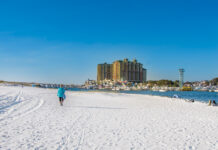

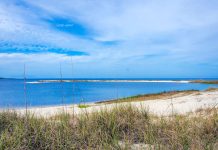
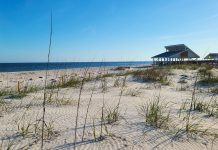
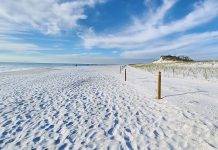
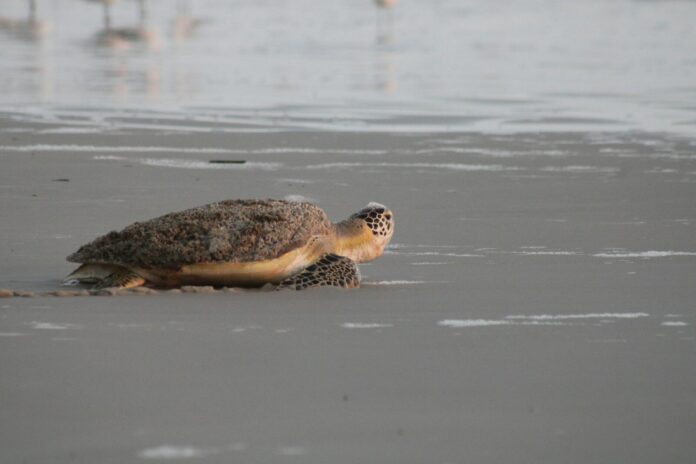
If I’m walking a Florida beach between May and October, I am not just walking. I am scanning. Every stretch of undisturbed sand between the dune line and the water gets a look, because somewhere on that beach, most nights, a two hundred pound turtle came ashore in the dark and did something extraordinary while the rest of us were asleep. I wrote a whole informational piece on FloridaSmart covering the species, the seasons, the rules, and the organizations behind all of it, you can read the full breakdown here if you want the numbers. This one is different. This is the version where I tell you what it’s actually like to go looking, where I’d take you if you asked, and why I’ve become the person who will absolutely stop mid-conversation to point at a track in the sand.
Why I Never Walk the Same Beach the Same Way Again
Florida holds close to 90 percent of all sea turtle nesting in the continental United States. I already knew that stat before it meant anything to me. It became real the first time I found a fresh crawl, that unmistakable tractor-tread path running up past the high tide line and back down again, and realized it had happened hours earlier, a few feet from where I’d probably walked the day before without noticing a thing. Once you know what you’re looking at, you cannot unknow it. Every beach walk becomes two walks at once, the one you’re taking and the one a nesting turtle took the night before.
Reading the Sand
Here’s what I actually look for now. A nesting crawl is wide and symmetrical for loggerheads and greens, more of a drag mark for leatherbacks, and it always runs in a relatively straight line from the water to wherever she decided to dig. Sometimes that line just turns around and heads back to the ocean without a nest at the end of it, a false crawl, and I used to think that meant something had gone wrong. It usually just means she didn’t love the spot. No harm done, she’ll try again in a night or two, somewhere down the beach.
If a nest was found and confirmed, you’ll usually see it marked, stakes and tape, sometimes a screen staked over the top to keep raccoons out, occasionally a small sign with the species and the date. That marked square is the one part of the beach that is not yours anymore for the season. I keep a wide path around it, I don’t let curiosity win, and if I’m walking with someone who wants to get closer for a photo, I’m the annoying friend who says no. I’ve made peace with being that friend.
Early morning is the best time to go looking, right after sunrise, before the beach fills in and before the heat sends the patrol volunteers home. If you see someone in a reflective vest walking slow with a clipboard and a GPS unit at that hour, that’s a permitted nest surveyor doing the real work, documenting every crawl on that stretch of beach before the day’s footprints erase the story. I’ve stopped a few of them just to ask questions. Every single one has been happy to talk.
Region by Region
The Panhandle
Perdido Key
Sea turtles nest here all summer, mostly loggerheads with the occasional green mixed in. The island sits inside Gulf Islands National Seashore, so nests get federal-level protection, and volunteer patrols walk the beach at dawn all season looking for fresh crawls before the day’s foot traffic erases them.
Pensacola Beach
Sea turtles nest steadily along Pensacola Beach’s eight miles of Santa Rosa Island, most of it inside Gulf Islands National Seashore. Loggerheads are the main species, and because so much of the island is protected seashore instead of dense development, nest survival rates here tend to run better than on more built-up stretches of Gulf coast.
Navarre Beach
Sea turtles get serious attention here thanks to the Navarre Beach Sea Turtle Conservation Center, a small nonprofit with its own resident turtle ambassador. Green, loggerhead, leatherback, and the occasional Kemp’s ridley all use this beach, with nesting running May through October.
Fort Walton Beach & Okaloosa Island
Sea turtles, mostly loggerheads, nest along this stretch every summer, and complimentary guided night walks run here through the Okaloosa County Sea Turtle Program if you’d rather have a ranger narrate the experience than hope to stumble onto one yourself.
Destin
Sea turtles favor the tall dunes at Henderson Beach State Park for nesting, mostly loggerheads, with activity peaking June through August, right in the thick of Destin’s busiest tourist season. Nest markers and roped-off sections are a normal sight on the beach in summer.
30A & South Walton (Grayton Beach, Seaside, Rosemary Beach, WaterColor)
Sea turtles nest quietly on the dune-backed stretches along 30A, mostly loggerheads, and South Walton Turtle Watch volunteers walk the sand every morning in season. Even the most photographed beach towns in the state are, underneath it all, working nesting beaches.
Panama City Beach
Sea turtles have been tracked here by Panama City Beach Turtle Watch since 1991, mostly loggerheads with occasional greens and leatherbacks mixed in, across 18 miles of shoreline from St. Andrews State Park to Camp Helen State Park. Peak nesting runs mid-June through early July, with hatching following in late August and September.
Cape San Blas & St. Joseph Peninsula
Sea turtles nest here in the largest numbers found anywhere in Northwest Florida, protected by St. Joseph Peninsula State Park and a dedicated volunteer Turtle Patrol that marks and screens every nest against predators.
St. George Island
Sea turtles, mostly loggerheads with occasional greens, nest quietly across this remote barrier island, watched over by the St. George Island Volunteer Turtlers who document activity each summer.
Tampa Bay & Pinellas County
Honeymoon Island & Caladesi Island State Parks
Sea turtles nest on both of these naturally intact barrier islands, mostly loggerheads and greens, with rangers running seasonal monitoring on each. The lack of heavy beachfront development helps nest survival in a way that’s increasingly rare this close to Tampa.
Clearwater Beach & Sand Key
Sea turtles nesting here are mostly loggerheads, with greens fairly common and rarer leatherback and Kemp’s ridley visits rounding things out. Clearwater Marine Aquarium anchors the region’s rescue and rehab work.
St. Pete Beach & Treasure Island
Sea turtles nest steadily along this stretch, mostly loggerhead and green, with local volunteer patrols walking the beach each morning through the season and marking new nests before the day’s crowds arrive.
Fort De Soto Park & Egmont Key
Sea turtles nest consistently here, mostly loggerheads, in a setting less developed than the resort beaches just north, closer to what the whole Pinellas coast probably looked like fifty years ago.
Southwest Florida
Anna Maria Island
Sea turtles nest here in some of the Gulf coast’s highest numbers, thanks partly to an island that never built the high-rises that create light pollution elsewhere. Anna Maria Island Turtle Watch and Shorebird Monitoring documented more than 31,000 hatchlings in a single record year and runs a well-loved adopt-a-nest program.
Longboat Key
Sea turtles, mostly loggerheads, nest here alongside Anna Maria and the Sarasota beaches to the south, with volunteer patrols covering the full key each morning during season.
Lido Key & Siesta Key
Sea turtles nest along both keys under one of the most active monitoring programs in the state, with Sarasota County volunteers surveying the beach every single morning from May through October. Siesta’s famously fine quartz sand and calm Gulf water make it easy to spot a nest marker, or some mornings, a turtle offshore before the beach fills in.
Venice & Manasota Key
Sea turtles nest consistently on these Sarasota and Charlotte county beaches, tracked by the same regional volunteer network that covers Siesta and Longboat Key. Venice is better known for shark teeth, but the turtles are working this beach at the same time you’re digging.
Boca Grande / Gasparilla Island & Cayo Costa
Sea turtles nest in strong numbers on these quieter, harder to reach barrier islands, with very little light pollution since Cayo Costa in particular is boat access only.
Sanibel & Captiva Islands
Sea turtles nesting here are documented daily by the Sanibel-Captiva Conservation Foundation, one of the most respected sea turtle programs in the state, with nighttime tagging, daily nest checks, and full rehab capability. A recent season saw over 340 nests documented by early June alone.
Fort Myers Beach
Sea turtles nest along Estero Island, mostly loggerheads, monitored under the same Lee County volunteer network that covers Sanibel and Captiva just across the pass.
Naples & Keewaydin Island
Sea turtles nest in some of southwest Florida’s highest densities on Keewaydin Island’s undeveloped, boat-access-only shoreline, with hundreds of protected nests each season. Rookery Bay National Estuarine Research Reserve and the Conservancy of Southwest Florida both track activity along Collier County’s beaches.
Marco Island
Sea turtles, mostly loggerhead and green, nest here each summer under the same Collier County conservation network active at Naples.
The Florida Keys
Key Largo & Islamorada
Sea turtles nest more sparsely here than at the Dry Tortugas, but loggerheads and greens both use the Upper Keys, and this is prime water for spotting turtles feeding on grass flats and reef year round, nesting season or not.
Marathon
Sea turtles are practically guaranteed here thanks to The Turtle Hospital, the Keys’ best known rehab center and public tour destination, worth a stop even outside nesting season for its resident patients.
Bahia Honda State Park
Sea turtles nest at Bahia Honda State Park, regularly ranked among the best beaches in the country, mostly loggerhead and green. There’s even a section of the park literally named Loggerhead Beach.
Key West
Sea turtles are a common nearshore sighting right off Key West, which also serves as the jumping off point for the real nesting hotspot of the entire Keys, seventy miles out to sea.
Dry Tortugas National Park
Sea turtles nest here more than anywhere else in the Florida Keys, monitored daily by Park Service biologists since 1980. Five species, green, loggerhead, Kemp’s ridley, hawksbill, and leatherback, have all been documented, and it’s the single most productive spot in the Keys for green and loggerhead nesting. Ponce de León named the islands “Las Tortugas” back in 1513 for exactly this reason.
Miami-Dade & Broward
Bill Baggs Cape Florida State Park / Key Biscayne
Sea turtles nest steadily at the southern tip of Key Biscayne, mostly green and loggerhead, on a protected, relatively low-light beach despite sitting in the middle of the Miami skyline.
Miami Beach
Sea turtles nest on South Beach, which surprises most visitors. The City of Miami Beach significantly strengthened its Turtle Nesting Protection Ordinance in 2024, tighter lighting rules and vehicle restrictions during nesting season, a genuinely notable conservation story in a city not usually associated with dark, quiet beaches.
Hollywood & Dania Beach
Sea turtles nest along this stretch under Broward County’s Sea Turtle Conservation Program, run by Nova Southeastern University for more than 30 years across 24-plus miles of Broward beaches.
Fort Lauderdale
Sea turtles nest here every summer, and guided beachfront turtle walks run near the Riverwalk with experts from the Museum of Discovery and Science. The nonprofit Sea Turtle Oversight Protection, known locally as S.T.O.P., runs community education and even lets participants name individual hatchlings.
Pompano Beach & Deerfield Beach
Sea turtles nest along these northern Broward County beaches within the same NSU-run monitoring program, mostly loggerhead with green and occasional leatherback activity mixed in.
Palm Beach County & the Treasure Coast
Boca Raton
Sea turtles nest here under a conservation program running continuously since 1977, with Gumbo Limbo Nature Center anchoring both research and public guided walks. Boca recorded over a thousand nests across all species in a recent season and set a local leatherback nesting record the following year.
Delray Beach & Boynton Beach
Sea turtles nest densely along this stretch of Palm Beach County, mostly loggerhead and green, within the same conservation umbrella as Boca Raton and Juno Beach just up the coast.
Palm Beach & John D. MacArthur Beach State Park
Sea turtles nest at John D. MacArthur Beach State Park, which also houses a rehabilitation facility, sitting right along one of the busiest loggerhead corridors in the country.
Juno Beach
Sea turtles nest here in some of the densest numbers on the entire planet, and Juno Beach is home to the Loggerhead Marinelife Center, a free-admission sea turtle hospital, research center, and the single best known guided turtle walk program in Florida. Tuesday through Saturday nights in June and July, under a state permit, you can watch a loggerhead nest a few feet away.
Jupiter & Jupiter Island
Sea turtles continue the same dense nesting corridor running north from Juno Beach here, with additional patrol coverage from Loggerhead Marinelife Center’s research area.
Hobe Sound
Sea turtles are the whole draw at Hobe Sound Nature Center’s FWC-permitted guided walks, held Thursday and Friday nights each June and July at Hobe Sound Public Beach. Loggerhead is the only species the center is permitted to show visitors.
Stuart & Jensen Beach / Hutchinson Island
Sea turtles log hundreds of nests here each season, mostly loggerhead with green and leatherback also present. Florida Power and Light runs turtle walks through its Energy Encounter Center, and the Florida Oceanographic Society offers year-round marine exhibits including live sea turtles.
Fort Pierce
Sea turtles nest within the same dense Treasure Coast corridor that runs through St. Lucie County, with Fort Pierce Inlet State Park contributing to some of the strongest seasonal totals on the east coast.
Vero Beach
Sea turtles laid over 11,000 nests across all species here in a recent season alone. Coastal Connections and the Friends of Sebastian Inlet State Park both run popular guided turtle walks, with reservations opening every May 1, and Disney’s Vero Beach Resort runs its own beachfront conservation program including the well known Tour de Turtles tracking event each summer.
Sebastian Inlet & Melbourne Beach (Archie Carr National Wildlife Refuge)
Sea turtles nest here in greater numbers than almost anywhere else in the Western Hemisphere. The Archie Carr National Wildlife Refuge, 20.5 miles of protected beach named for the researcher who pioneered sea turtle science, sees 15,000-plus loggerhead and 20,000-plus green nests in strong years. The refuge itself doesn’t run public walks, but the Sea Turtle Conservancy leads guided watches along it.
The Space Coast
Satellite Beach & Indialantic
Sea turtles nest heavily along this stretch inside the Sea Turtle Preservation Society’s core patrol territory, contributing to Brevard County’s position as one of the two or three most important nesting stretches in the country.
Cocoa Beach
Sea turtles nest consistently here each summer on one of the most visited beaches in the state during turtle season. Nest markers along the public beach are simply part of the summer scenery.
Cape Canaveral & Canaveral National Seashore
Sea turtles nest along one of Florida’s longest undeveloped coastlines, roughly 6,000 nests a year across loggerhead, green, leatherback, and occasional Kemp’s ridley and hawksbill. Canaveral National Seashore runs ranger-led Sea Turtle Watch programs each June and July out of the Apollo Beach Visitor Center near New Smyrna Beach.
Northeast Florida
New Smyrna Beach
Sea turtles nest heavily near the gateway to Canaveral National Seashore’s Apollo Beach district, with over a thousand nests reported most seasons and a strong ranger-run program.
Daytona Beach
Sea turtles nest regularly along Volusia County’s long, famous beach, mostly loggerheads, with public education campaigns each spring reminding beachgoers and drivers, since this is one of the few beaches with legal beach driving, to watch for nests and hatchlings.
Flagler Beach
Sea turtles nest along the stretch protected by Gamble Rogers Memorial State Recreation Area, mostly loggerheads, in this smaller, quieter beach town between Daytona and St. Augustine.
St. Augustine / Crescent Beach / Anastasia State Park
Sea turtles nest along nearly four miles of shoreline monitored seven days a week through the season by the Crescent Beach Sea Turtle Patrol, with Anastasia State Park adding another protected stretch of habitat nearby.
Ponte Vedra Beach
Sea turtles nest along this stretch monitored by Mickler’s Landing Turtle Patrol and the Sea Turtle Patrol of South Ponte Vedra Beach, part of the broader northeast Florida nesting corridor that runs down through St. Augustine.
Jacksonville Beach, Neptune Beach & Atlantic Beach
Sea turtles nest along this Duval County stretch covered for decades by the Beaches Sea Turtle Patrol, which reported a record-breaking number of nests in recent seasons, loggerhead, green, and leatherback all documented here.
Amelia Island / Fernandina Beach
Sea turtles nest here in lower density than South Florida, but Amelia Island Sea Turtle Watch runs an active monitoring and public excavation program, typically starting in early to mid July, where you can watch volunteers inventory a hatched nest and, sometimes, release lingering live hatchlings right there on the sand.
The Guided Walks I’d Actually Book
If you want more than a lucky morning find, Florida has some of the best public sea turtle walk programs anywhere in the world, and I’ve put together the shortlist I’d actually hand a friend.
Juno Beach, through the Loggerhead Marinelife Center, runs the most well known guided walk program in the state, Tuesday through Saturday nights in June and July under a state permit. It’s free admission to the center itself, and this stretch of beach is one of the densest loggerhead nesting beaches on Earth, so your odds here are about as good as they get.
Boca Raton, through Gumbo Limbo Nature Center, has been running a serious conservation program since 1977 and offers guided walks with the same combination of research center, hospital, and public education that makes Juno Beach so good.
Hobe Sound, through Hobe Sound Nature Center, runs FWC-permitted walks Thursday and Friday nights each June and July, meeting right at the public beach. Loggerhead only on these walks, but it’s a quieter, smaller group experience than some of the bigger programs.
Vero Beach has two solid options, Coastal Connections and the Friends of Sebastian Inlet State Park, both running popular guided walks with reservations opening every May 1. Book the second that window opens. These fill up.
On the Gulf side, Anna Maria Island and Sanibel and Captiva don’t run the same style of nighttime guided walk, but both have exceptional daytime programs, nest updates, and public excavation events through Anna Maria Island Turtle Watch and the Sanibel-Captiva Conservation Foundation, where you can watch volunteers dig out a hatched nest a few days after it empties and, sometimes, help release a hatchling that didn’t quite make it out on its own.
Building a Trip Around Them
If I were planning a turtle-focused trip from scratch, I’d pick one of two versions. The Treasure Coast version means basing yourself somewhere between Jupiter and Vero Beach in June or early July, booking a Juno Beach or Hobe Sound walk for one night, and leaving the rest of your trip loose enough to just walk the beach at sunrise looking for crawls the other mornings. This stretch of coast, running up through the Archie Carr National Wildlife Refuge, is the single most important loggerhead nesting habitat in the Western Hemisphere, so you are, quite literally, in the best possible place on the planet to be doing this.
The Gulf coast version is quieter and a little less scheduled. Base yourself on Anna Maria Island or Sanibel, skip the reservation scramble, and just build turtle-watching into your regular beach mornings instead of one big scheduled event. Check the local turtle watch social pages before you go, they usually post nest counts and excavation dates in real time.
Either way, book early. May 1 is the unofficial start date for a lot of these reservation systems, and the good walk dates go fast once June hits.
The Rules I Don’t Bend On
I’ll be honest, I get a little protective about this. No flash photography, ever, not even one shot with the flash accidentally left on. No flashlights or phone lights pointed anywhere near the water at night in season, and if my phone screen is even glowing too brightly while I’m walking after dark, I dim it. Ten feet of distance minimum from any turtle or hatchling, more if a guide tells you more. If I dig a hole in the sand during the day, I fill it back in before I leave, every time, because an uncovered hole is exactly the kind of thing that can trap a nesting female or send a group of hatchlings the wrong direction. I pack out my chairs and tents at night instead of leaving them on the beach. And if I ever see a hatchling heading toward a lit building instead of the water, I am not touching it, I am calling FWC’s wildlife hotline and letting someone permitted handle it.
None of this is complicated. It’s just a short list of things I’m simply not willing to be careless about, on a beach that isn’t only mine.
Questions People Ask Me All the Time
Can I really just show up and see one?
Sometimes, but it’s genuinely luck. A guided walk gets you a trained spotter and a much better shot, but even then nothing is guaranteed. Nature doesn’t do reservations, even when the tour does.
What if I find a nest on my own morning walk?
Don’t touch it, don’t mark it yourself, and if it isn’t already flagged, report it. Local turtle patrol groups want to know, and most have an easy way to reach them through their website or social pages.
Is it worth doing this with kids?
Completely, and honestly some of the guided programs are built with exactly that in mind. Just prep them ahead of time that quiet and patient is the whole deal, not a given for every kid, but worth the conversation beforehand.
Which coast is better, Atlantic or Gulf?
For sheer nesting density and guided walk options, the Atlantic side wins, especially the Treasure Coast and Space Coast corridor. For a quieter, less scheduled experience, I lean Gulf.
Thoughts & Reflections
There’s a version of me from a few years ago who would have walked right past a turtle crawl without a second glance, in a hurry to get to wherever I thought I was supposed to be going. I think about that a lot now, how much I used to miss simply because I wasn’t looking. Learning to read a beach for turtle tracks didn’t just teach me about turtles. It taught me, again, that slowing down is basically a superpower disguised as an inconvenience.
