

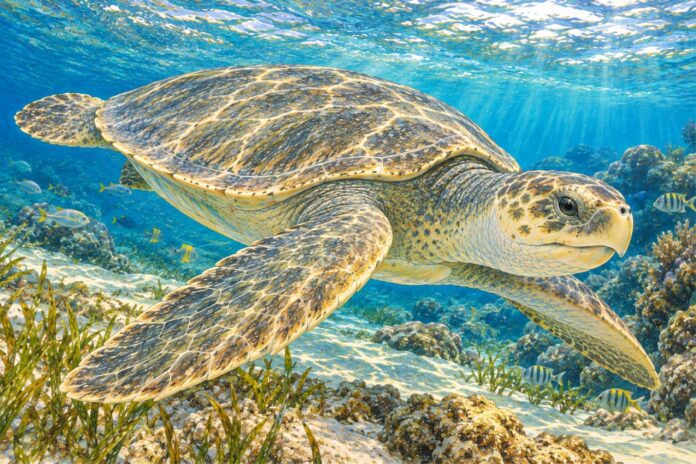
Meet the Flatback
The flatback is the sea turtle with the smallest passport. She nests only in Australia, and unlike every other turtle in this series, she never leaves the continental shelf for the deep open ocean. She lays fewer eggs than other sea turtles, about 50 a clutch, but her eggs and hatchlings are proportionally larger, and from the moment she is born she is a homebody of the warm, shallow waters off northern Australia. She feeds on sea cucumbers, jellyfish and soft corals, and she shows up in just three countries in all, Australia, Papua New Guinea and Indonesia.
Her shell tells you the rest. It is low and flat, with edges that curl upward like a shallow tray, and the plates are thin and waxy, with an almost matte, pale olive-gray look. Her belly is a creamy white, her head is small and rounded, and she has four pairs of plates down each side and a single pair of scales between her eyes. At around three feet long, she can look a bit like a green turtle at a glance, but the flatter shell, the upturned edges and the pale waxy finish set her apart. And if you are standing on an Australian beach, location itself is a good clue. The State of the World’s Sea Turtles flatback profile has more. A turtle that never leaves home is the perfect one to end this series with, and her sand is a story of its own.
The Sand Sfor the Flatback
Every turtle in this series so far has been defined, at least a little, by distance. Leatherbacks cross entire ocean basins. Loggerheads cross the Mediterranean. Olive ridleys migrate thousands of miles just to join a crowd. The flatback doesn’t do any of that. She’s the only sea turtle species on the planet that nests in exactly one country, and it turns out that’s not the only way she stays close to home. Unlike every other species in this series, she spends her entire life on the shallow continental shelf around northern Australia, never once crossing into the deep open ocean the rest of her family calls home. This is the seventh and final turtle in this series, and fittingly, she’s the one who never really left.
Her low-domed shell with its distinctive upturned edges gives her name, and her nesting habits are just as distinctive. She lays fewer eggs than any other species, an average of 50 per clutch against the 80 to 150 most turtles lay, but those eggs are proportionally larger, which may help hatchlings survive the crawl to the water. Because her entire range is confined to a relatively narrow band of northern Australian coastline, she doesn’t need the same pickiness other species show about sand texture or slope. Her whole world is already a small one. She just needs to find her spot within it.
The Shifting Sand of Crab Island
Crab Island, a remote, uninhabited, crescent-shaped island in the western Torres Strait, holds the largest flatback nesting concentration on Earth, sometimes close to a thousand turtles coming ashore in a single night. The sand here is a genuinely unusual mix of silica and finely broken mollusc shell, on an island that researchers describe as actively shifting, its shape changing over time as currents rework the sandbar connecting its two vegetated ends. In calm weather, fresh tracks can stay legible in that damp sand for up to two weeks. In a strong wind, they can disappear within days. Even the record of who was here recently depends entirely on what the weather decided to do.
The Turtle Beach Inside a Gas Plant
I want to tell this one honestly rather than tie it up neatly, because it doesn’t tie up neatly. Barrow Island, off the Pilbara coast of Western Australia, is one of the most important flatback and green turtle nesting sites in the entire northwest of the country. It’s also home to one of Australia’s largest natural gas processing facilities. Both of those things are true on the same stretch of sand at the same time. The company operating there has committed tens of millions of dollars to a long-term flatback conservation program, tags thousands of nesting females, and has shifted much of its outdoor lighting to lower-intensity, orange-tinged fixtures specifically because white light disorients nesting turtles and hatchlings. Environmental groups have also raised real, documented concerns about facility lighting, pollution, and rising sand temperatures on the very beaches turtles depend on. I’m not going to pretend I know how that tension resolves. I don’t think anyone fully does yet. What I know is that this is what conservation actually looks like most of the time, not a finished success story, but an ongoing, imperfect negotiation happening in real time on real sand.
The Territory’s Turtles That Never Stop Nesting
Further west, on Bare Sand Island and along Fog Bay in the Northern Territory, flatbacks do something most sea turtles don’t bother with, nesting nearly year-round instead of concentrating into one tight seasonal window. It’s a reminder that even within a single species confined to a single country, the rules can look different from one stretch of coast to the next. Some beaches keep a strict calendar. This one barely bothers with one at all.
Back to Mon Repos
If her name sounds familiar from earlier in this series, it should. Mon Repos, in Queensland, sits at the southern edge of her range and is one of the only places on Earth where you can watch a flatback nest alongside a loggerhead on the very same stretch of shifting sand. I covered that beach in more detail in the loggerhead piece, but it’s worth repeating here, because it means her story and the very first turtle in this series both end up standing on the same ground.
Her Track and Her Life on the Shelf
A flatback’s track is broad and relatively shallow, matching her low, flattened shell, and her nest sits a little less deep than what you’d find from a loggerhead or green. But the more remarkable fact isn’t in the sand at all. It’s in the water just past it. While every other turtle in this series eventually swims out across an ocean basin, sometimes several, a flatback stays on the continental shelf her entire life, feeding on sea cucumbers, jellyfish, and soft coral in the same relatively shallow waters she was born into. She is, in the truest sense, a homebody.
Country by Country: Everywhere She Nests and Feeds
This is the easiest country-by-country list in the series, and it makes a point. The flatback’s whole life fits into three countries, and she nests in only one of them. According to the State of the World’s Sea Turtles profile of the flatback, here is the entire map.
Australia: Where She Nests and Feeds
Flatbacks nest only in Australia, from Mon Repos in southeast Queensland across the north of the country to the Pilbara in Western Australia. The key rookeries named in the profile:
- Queensland: Mon Repos near Bundaberg, and Crab Island in the western Torres Strait.
- The Northern Territory: Bare Sand Island and Fog Bay.
- Western Australia: Barrow Island (around 1,700 nesting females a year on the east coast), Mundabullangana Beach (around 1,600), Eighty Mile Beach, Cape Domett, the Montebello Islands, and the Dampier Archipelago and island chains between it and Exmouth Gulf. Those last few each draw hundreds to thousands of females.
She feeds across the northern Australian continental shelf as well, including the Pilbara and Kimberley coastlines. Satellite tracking found a large share of feeding locations, between 41 and 72 percent depending on the study, in water 50 to 100 meters deep, 100 to 1,000 kilometers from the nesting beach. Dive records suggest flatbacks rarely go deeper than about 45 meters.
Papua New Guinea and Indonesia: Where She Only Feeds
Papua New Guinea’s territorial waters and the waters of southern Indonesia are the two countries outside Australia where flatbacks are known to feed. Neither has a nesting beach for her. It is the shortest passport in the series, and I find it oddly moving. Every flatback in the world was born in Australia, and her whole life stays within about a thousand kilometers of that same sand.
Where You Can Go Stand on That Sand
Mon Repos remains the most accessible place to see a flatback in person, through the same ranger-led Turtle Encounter tours that cover the resident loggerheads there. Crab Island is a genuine expedition, remote, boat-access only, and largely the domain of researchers rather than casual visitors. Barrow Island isn’t open to public tourism at all, a working industrial site rather than a destination, though its long-term monitoring data has become an important part of understanding this species precisely because so few other flatback populations get studied this closely, for better and worse.
Thoughts & Reflections
After six turtles defined by distance, ocean crossings, ancient migrations, entire hemispheres, there’s something almost restful about a species that just… stayed. She never needed to prove anything by leaving. Her whole life fits inside one relatively small, well known stretch of water, and that’s not a smaller story than the leatherback’s. It’s just a different shape of story, one built on depth in one place instead of breadth across many. I think I needed the reminder, after all this research into turtles that cross entire oceans, that staying close to home and knowing that water intimately is its own kind of accomplishment.
And I think it’s fitting that the last turtle in this whole series is also the one whose story refuses to wrap up cleanly. Barrow Island doesn’t resolve into a tidy lesson. It’s an actual, ongoing negotiation between industry and survival, happening in real time, with real effort and real damage both still on the table. If I’m honest, that’s a truer note to end this series on than another clean redemption arc would have been. Most of the meaningful work in my own life hasn’t wrapped up neatly either. It’s ongoing too, imperfect, still being negotiated, still worth showing up for anyway.
