









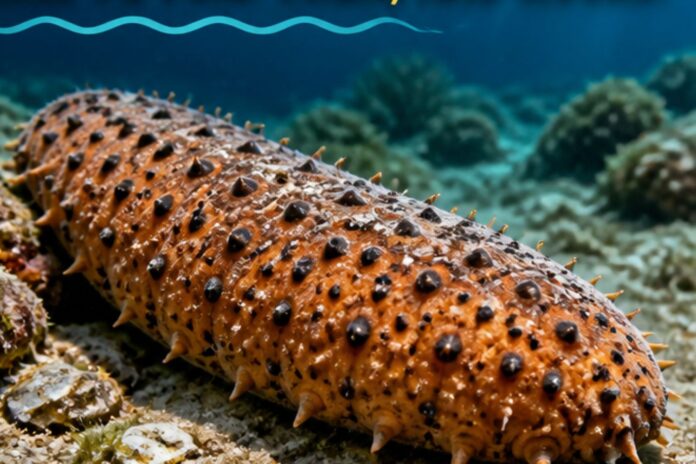
The first time you see a sea cucumber, you might think it is a log, a lost sock, or something a dog left behind on the seafloor. It is none of those. It is an echinoderm, a cousin of sea stars and sand dollars, and one of the hardest working animals on any sandy bottom. It spends its whole life eating sand, cleaning it, and putting it back, and I think that makes it the most underrated sand lover in the ocean.
If you love beaches, tide pools, and the quiet magic of life under the sea, echinoderms: sea cucumbers deserve a spot on your curiosity list. They may not be the flashiest creatures on the reef, but they are some of the most fascinating. Slow-moving, soft-bodied, and wonderfully strange, sea cucumbers are the ocean’s sandy little cleanup crew.
What Is a Sea Cucumber?
A sea cucumber is a soft, long bodied echinoderm that lies on its side on the sea floor. It has no arms and no hard shell. Instead of a skeleton like a sea urchin’s, it has a leathery body wall with tiny bone fragments embedded in it. At one end is a ring of branching tentacles around the mouth, and at the other end is the back door. Their shape really does resemble a cucumber, which is exactly how they got their name.
Sea cucumbers breathe through a set of internal tubes called respiratory trees, which draw water in through the rear opening. They belong to the class Holothuroidea, and they still show the five part symmetry that marks the whole family, though you have to look closely to see it.
How Many Species of Sea Cucumbers Are There?
Around 1,400 species are known, and new ones are still being described, with some counts running higher. They live in every ocean at every depth, from shallow grass flats to the deepest trenches, where they can make up most of the animal life on the bottom. Some of the ones you may meet:
- Three-rowed sea cucumber (also called the chocolate chip cucumber), Isostichopus badionotus: a brown to tan, bumpy cucumber, very common in the shallow sand and seagrass of Florida and the Caribbean.
- Donkey dung sea cucumber, Holothuria mexicana: a thick, dark, sluggish cucumber of Caribbean and Florida sand flats, and yes, that is its real name.
- Florida sea cucumber, Holothuria floridana: a smaller cucumber found on Florida’s shallow bottoms and reefs.
- Sandfish, Holothuria scabra: the Indo-Pacific cucumber that buries itself in sand, and one of the most valuable species in the dried sea cucumber trade.
- California sea cucumber, Apostichopus californicus: the large, reddish brown cucumber of the Pacific coast.
- Orange-footed sea cucumber, Cucumaria miniata: a bright feathery cucumber of Pacific Northwest rocks and tide pools.
- Black sea cucumber, Holothuria atra: a dark, sand covered cucumber of Indo-Pacific reef flats.
How Do Sea Cucumbers Move?
Slowly, and with style. Most sea cucumbers crawl along the bottom on rows of tube feet, stretching the body forward and then pulling the rest along in waves of muscle. Some burrow in the sand, and a few deep sea species can swim by flapping their bodies. If you watch a sea cucumber for a few minutes you might think nothing is happening, but they are moving, just at a pace that makes a snail look rushed. Many are most active at night or when tides bring food.
What Do Sea Cucumbers Eat?
Sand, mostly, or rather what lives in it. Many sea cucumbers are deposit feeders. They push the sediment into their mouths with their tentacles, digest the algae, bacteria, and tiny bits of organic matter that coat each grain, and pass the cleaned sand out the other end. Others are suspension feeders, and they hold out sticky, branching tentacles to catch plankton drifting by. Either way, the sea cucumber is the ocean’s recycler. Researchers have estimated that some species process hundreds of pounds, and by some estimates more than a ton, of sediment a year per animal, which is why they are sometimes called the earthworms of the sea.
Sea cucumbers have some of the most interesting reproduction methods in the sea. Most species reproduce sexually, releasing eggs and sperm into the water at the same time. This is called broadcast spawning.
Sexual reproduction
Here’s how it works:
- Adults release eggs and sperm into the water.
- Fertilization happens externally.
- Tiny larvae develop and drift with ocean currents.
- The larvae settle to the seabed and slowly grow into juveniles.
This drifting larval stage helps sea cucumbers spread across large areas of the ocean. That’s one reason they appear in so many different regions worldwide.
Asexual reproduction
Some species can also reproduce asexually by splitting into parts or regenerating lost tissues. Sea cucumbers are famous for their regeneration powers. If threatened, some species can even eject internal organs to distract predators, then regrow them later.
Sea cucumbers are also famous for their defenses. A threatened cucumber may expel part of its internal organs through its back end, which distracts a predator while the animal escapes, and then it grows new ones. Some tropical species shoot out sticky white threads to tangle an attacker.
Sea Cucumbers and Sand: The Sand Cleaners
This is my favorite thing about sea cucumbers, and it is why I wanted a whole article for them. Sea cucumbers are the sand’s housekeepers. A deposit feeder scoops up the top layer of sand, strips off the algae and bacteria, and leaves a little pile of clean, finely processed grains behind. Do that for millions of cucumbers across thousands of miles of sandy bottom and you get sand that has literally passed through an animal. There are even clues in the sand. A line of coiled sand sausages on a grass flat is a sea cucumber’s calling card. Research on reefs also suggests that cucumber waste helps buffer the water against acidification, which is a surprising gift from something that looks like a dropped sausage. The sand on your favorite beach got there with a lot of help, and sea cucumbers are on the list.
Can You Touch Sea Cucumbers?
You will see a lot of photos of people holding sea cucumbers, and I understand the pull. They are soft, they hold still, and they feel strange. But handling is stressful for the animal. A squeezed or startled cucumber may expel its organs, and lifting one from the water exposes it to air, heat, and our sunscreen. Some species also carry irritating toxins.
The best way to meet a sea cucumber is the way it prefers: slowly, from above, in the water, with your hands to yourself. If you must move one out of harm’s way, support the whole body gently and keep it under water. The best rule is simple: look, but do not touch.
Why you should not touch them
- Touching can stress or injure the animal
- Some species are protected by local laws
- Their skin can be delicate and easily damaged
- Human contact can introduce harmful bacteria or pollutants
Why you should not collect them
Collecting sea cucumbers from the wild can harm local ecosystems. In some places, they are commercially harvested and face population pressure. Removing them for souvenirs, tanks, or curiosity is not responsible and may be illegal.
If you want a closer look, observe them in their natural habitat or visit a public aquarium. That way, you can admire their charm without disturbing their home.
Where Do Sea Cucumbers Live?
Sea cucumbers live in oceans all over the world. They are found in:
- Tropical coral reefs
- Shallow sandy bays
- Seagrass beds
- Rocky coastlines
- Deep-sea habitats
Some species prefer warm, clear tropical waters, while others thrive in chilly deep ocean environments. They can be found from the intertidal zone, where waves wash over the sand, all the way down to the deepest seafloor habitats.
Where in the world can you find them?
Sea cucumbers inhabit nearly every ocean region, including:
- The Indo-Pacific
- The Caribbean
- The Mediterranean
- The Atlantic coastlines
- The Pacific Northwest
- Arctic and Antarctic waters, for certain species
If you’re beachcombing in tropical destinations like Indonesia, the Philippines, Hawaii, or the Great Barrier Reef, you may spot them in lagoons or reef flats. In temperate regions, they often hide under rocks or in tidal pools and sandy channels.
Popular Destinations to See Sea Cucumbers Around the World (and the Rules for Each)
Florida and the Florida Keys
Look for the three-rowed sea cucumber and other cucumbers on sandy grass flats and shallow reef edges, especially in calm, clear water at low tide. They are easy to spot when you know what to look for, because most of them are out in the open. Rules for harvesting depend on the species and the location, and parks and the Florida Keys National Marine Sanctuary protect living animals within their boundaries. Check the Florida Fish and Wildlife Conservation Commission before collecting anything.
The Caribbean
Sea cucumbers are everywhere on Caribbean sand and seagrass, often by the dozens. Snorkeling over a grass flat is the easiest way to see them, and many islands have rules about harvest and handling. Ask a local guide.
Panama
Bocas del Toro’s grass flats and reefs hold several species, including large cucumbers that sit in shallow water. Researchers working in the archipelago have studied how much sediment they process. The best views are from a boat or a snorkel. Panama’s laws on collecting marine life are strict, and the easy rule is to leave everything where you found it.
The Pacific Coast: Washington, Oregon, and California
The California sea cucumber is a large, reddish brown cucumber that lives on rocky and sandy bottoms and is popular with divers. The orange-footed sea cucumber is a Pacific Northwest tide pool favorite with feathery orange tentacles. Intertidal collecting rules vary by state and are strict in many places. Washington and Oregon protect tide pool animals, California requires a fishing license for most collecting, and marine protected areas generally ban collecting entirely. A commercial dive fishery for the California sea cucumber is regulated separately.
The Indo-Pacific
From the Great Barrier Reef to the reefs of Southeast Asia, sea cucumbers are common on shallow sand and reef flats. Sea cucumber fishing is a large industry here. Dried sea cucumber, known as bêche-de-mer, is sold across Asia, and many valuable species have been heavily overfished. If you are diving or snorkeling, enjoy the cucumbers in place. If you are buying seafood, ask where it comes from.
Who’s Protecting Sea Cucumbers
Sea cucumber conservation is still catching up with the demand for them. The IUCN Red List tracks the status of many species, and several valuable tropical species are listed as threatened or endangered because of overfishing. The Food and Agriculture Organization of the United Nations publishes guidance on managing sea cucumber fisheries. In the United States, NOAA Fisheries and state agencies manage collecting, and the Florida Keys National Marine Sanctuary protects living animals within its waters.
A Beach Lover’s Final Thought
Sea cucumbers may not sparkle like reef fish or glide with the drama of manta rays, but they are quietly magical. They are proof that the beach is not only about sunshine and shells, it’s also about the hidden life beneath the sand.
So next time you’re strolling the shoreline, snorkeling over a reef, or peering into a tide pool, remember the humble sea cucumber. It is one of the ocean’s most important little residents, working behind the scenes to keep the sea clean, balanced, and full of wonder.
Sea Cucumber Curiosity Corner
Is a sea cucumber an animal or a plant?
An animal. It is an echinoderm, related to sea stars, sea urchins, and sand dollars.
What do sea cucumbers eat?
Many eat sand and mud and digest the algae, bacteria, and organic bits in it. Others catch plankton with sticky tentacles.
How do sea cucumbers move?
They crawl on rows of tube feet and ripple their muscular bodies along. Some burrow in sand, and a few deep sea species swim.
How do sea cucumbers reproduce?
Most spawn eggs and sperm into the water, and the fertilized eggs become larvae that settle on the bottom. A few species can also reproduce by splitting in two.
How many species of sea cucumbers are there?
About 1,400 are known, and scientists keep describing more.
Can you touch a sea cucumber?
It’s better not to. Handling stresses them, and a startled cucumber may expel its internal organs. If you must move one, keep it underwater and support its whole body.
Why do sea cucumbers spit out their insides?
It is a defense. The organs distract a predator, and the cucumber regrows them over time.
Do sea cucumbers breathe through their butts?
Many do. They draw water in through the rear opening and pass it through internal respiratory trees.
Can you eat sea cucumbers?
Yes, in many cultures, especially in East Asia, where dried sea cucumber is a prized food. Heavy demand has led to overfishing of many species.
Why are sea cucumbers good for the beach?
They constantly process sand and sediment, recycling nutrients and cleaning the bottom, so they are an important part of how sandy habitats stay healthy.
